Understanding Peak Current in Jump Starter: STOP Fooled by 3000A/6000A Numbers!
Almost all car jump starter product packaging and product detail pages feature large text highlighting peak currents of 3,000 A, 4,000 A, or 6,000 A. When selecting a jump starter, many car owners directly compare peak ampere ratings, assuming that the higher the number, the stronger the vehicle’s starting power.
However, many car owners are unaware that there is no unified industry testing standard for peak current, and it cannot be directly equated with engine starting power. This article will break down the principles behind peak current in layman’s terms, compare it to CCA (Cold Cranking Amps), and share a jump starter selection guide that anyone can follow.
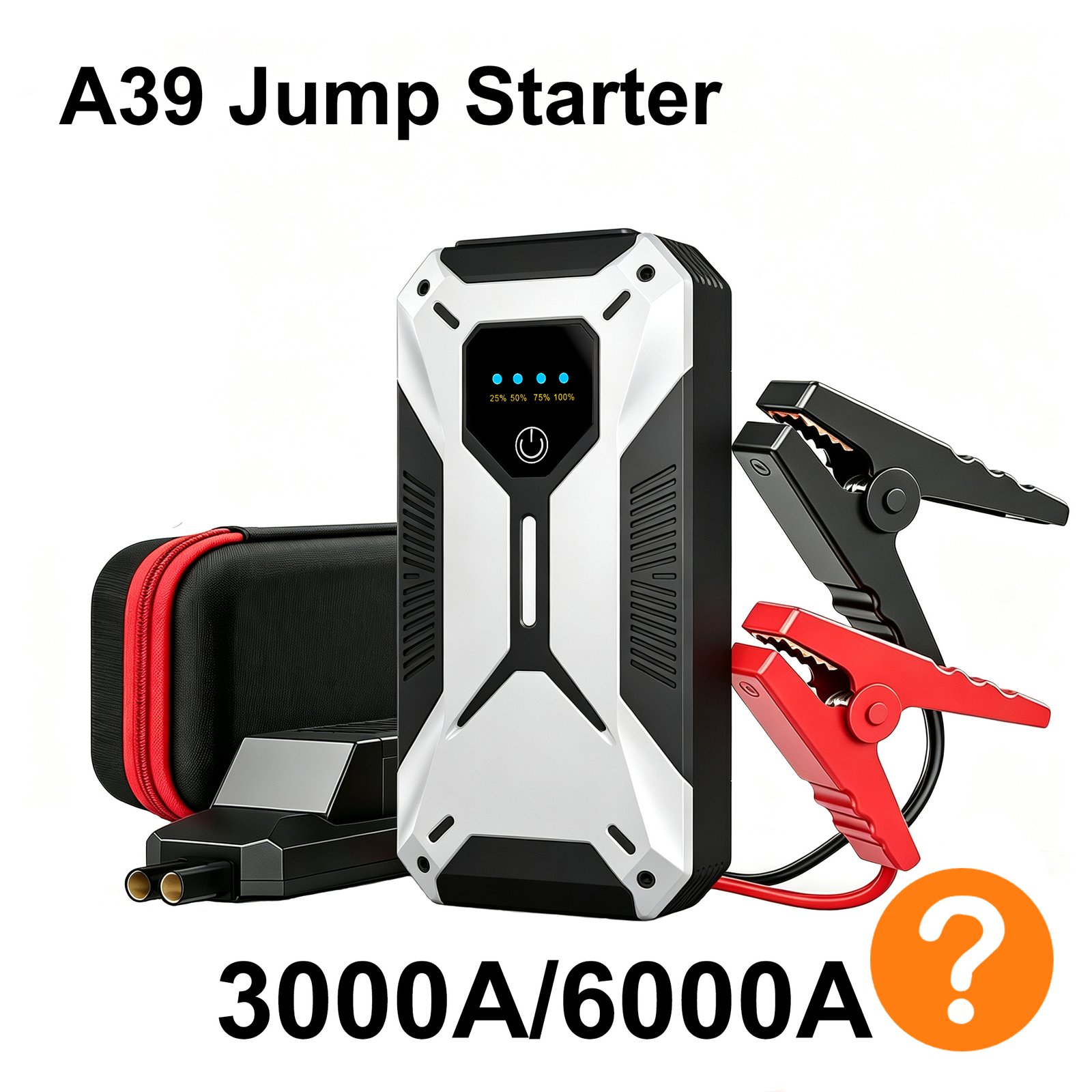
The Jump Starter prominent peak current is a specifically designed demonstration parameter.
When browsing jump starters at brick-and-mortar auto parts stores or on e-commerce platforms, you’re likely to be drawn to the huge ampere figures on the packaging, which are usually accompanied by images showing an SUV or off-road vehicle being started with the push of a button.
Most consumers, upon seeing these numbers, fail to consider several key questions:
At what ambient temperature was this current tested?
How long can the high current be sustained?
What load conditions and testing standards were used?
These factors directly determine whether this specification is actually meaningful.
“Peak current” sounds like a professional engineering metric. However, in the automotive emergency jump-start power supply industry, the peak current listed by manufacturers does not correspond to what most people understand as a “sustained high current capable of reliably starting an engine.” The core difference lies in the fact that there are no unified industry testing standards for peak current, allowing each manufacturer to define its own testing methods.
What is peak current? There is currently no standardized definition in the industry.
Clore Automotive, a long-established U.S. battery equipment manufacturer, provides a clear explanation of peak current in its technical documentation: Peak amperage is broadly defined as the maximum potential current released instantaneously when the positive and negative terminals of a jump starter are directly short-circuited. At the same time, the manufacturer explicitly warns that under normal usage conditions, directly short-circuiting the clamps is strictly prohibited.
Direct short-circuiting is an extreme operating condition that would never occur during routine jump-starting, yet the data measured under this condition is prominently displayed on the product packaging.
In terms of duration, technical documentation from several overseas brands specifies that peak current refers to an instantaneous current spike lasting milliseconds, or at most 1–3 seconds. Clore Automotive further points out that the peak is a fleeting value measured in microseconds. It can only be used to roughly determine whether a device has the potential to trigger a start; it does not directly indicate whether the vehicle will successfully start.
Key Point: There is no universally recognized industry standard for peak current. A Brand’s 6,000A peak and Brand B’s 6,000A peak are measured under completely different test conditions and cannot be compared directly. As an industry analogy goes, peak current is like a fleeting, momentary value, and the rules for defining it are set at the discretion of each manufacturer. The WOLFBOX Buying Guide notes: Peak current is an unregulated marketing parameter and has no direct correlation with a vehicle’s actual starting capability.
By contrast, the cold cranking amperage (CCA) of traditional automotive lead-acid batteries is governed by the internationally recognized SAE J537 standard: under conditions of -18°C, the output voltage must not fall below 7.2V after 30 seconds of continuous discharge. 7.2V is the minimum voltage threshold required for a car starter to operate stably; if the voltage falls below this value, the start is highly likely to fail.
CCA fixes three variables—temperature, discharge duration, and minimum voltage—allowing test results from different regions to be compared across the board. In contrast, peak current is not subject to such mandatory constraints.
A millisecond-level instantaneous surge is insufficient to support the entire engine startup process.
Starting an engine is not an instantaneous pulse; it is a process that must remain stable and continuous for several seconds. The complete startup cycle for a typical gasoline engine lasts approximately 0.6 to 0.8 seconds, while a diesel engine takes 1.2 to 1.4 seconds to start. During startup, the starter motor must overcome the resistance from piston compression, engine oil viscosity, and static mechanical friction to rotate the crankshaft until the engine ignites on its own. This entire process requires a continuous, stable output of high current.
However, the window for peak current delivery lasts only milliseconds. Hardware tester Brian Dipert conducted real-world tests on several jump starters rated for high peak currents and found that the 2,000A peak current spike often lasts less than 1 second; after the capacitor instantly discharges its charge, the current drops rapidly—at which point the starter motor has not yet begun to turn the engine over.
There is a rough industry reference ratio: peak current is generally 2 to 3 times the actual sustained starting current.
· Rated 1,000 A peak: sustained current approximately 300–500 A
· Rated 2,000 A peak: sustained current approximately 600–900 A
· Rated 4,000 A peak: sustained current approximately 1,200–1,500 A
This multiplier is not a universal industry standard. Peak values can be measured under ideal laboratory conditions—at 25°C room temperature, with the device fully charged, and low contact resistance. However, in real-world vehicle scenarios—which often involve low temperatures, deeply discharged original vehicle batteries, and oxidized jumper clamps causing higher contact resistance—the device’s actual output capacity will decrease significantly.
This is also a phenomenon frequently mentioned in buyer reviews: while the packaging states a peak of 6,000 A, the actual continuous starting current listed on the unit’s nameplate is only 500 A. In terms of labeling regulations, the seller is not in violation; it’s simply that the test conditions for the two figures are completely different.
Common Approaches to Promoting Peak Current
Prioritize peak current as the core selling point
The front page of product packaging and the first screen of e-commerce listings prominently feature peak current, paired with descriptions such as “instant start, powerful performance”; the continuous starting current—which truly reflects actual starting performance—is often placed at the bottom of the specifications table in very small font, requiring careful searching.
For example: Some products list a peak current of 1,800 A on the outer packaging, while the nameplate on the unit itself specifies the continuous starting current ratings: 300 A for 3 seconds, 400 A for 2 seconds, and 500 A for 1 second. Both sets of data are accurate; they simply describe different performance metrics.
Peak current figures are easily inflated during product iterations
For the same series of jump starters, when the battery cell configuration and BMS protection circuitry remain unchanged—but the casing is replaced and additional features like an air pump are added—the peak amperage of the new model increases significantly. Manufacturers are well aware internally that peak amperage does not represent actual performance, but in a competitive market where rival products all list high amperage figures, if a company’s product has a relatively low peak value, it is easily overlooked by consumers. As Clore Automotive noted: The practice of listing peak amperage is driven by market demand.
Explaining Discrepancies in Actual Test Results with “Ideal Conditions”
When users find that the actual jump-start performance falls short of expectations, sellers typically explain that the peak amperage was measured under ideal laboratory conditions, while actual starting performance is influenced by multiple factors, including the condition of the vehicle’s battery, ambient temperature, and engine operating conditions. Peak specifications not only create expectations of high performance but also provide a convenient explanation—citing differences in testing conditions—when actual results fall short.
To achieve high peak currents, the battery cells must undergo brief, extreme discharge cycles.
Conventional wisdom holds that higher specifications indicate better design margins and higher-grade materials. However, this logic does not fully apply to peak current specifications.
The peak current is an instantaneous spike captured when the battery cell is pushed to its limit for a very brief period. Although high-rate lithium-ion battery cells can briefly withstand high currents, short-term extreme discharge still generates heat, imposes mechanical stress on the cell’s interior, and accelerates the cell’s lifespan degradation.
The electrochemical characteristics of lithium-ion batteries make it difficult for them to deliver a high starting current steadily for 30 seconds, as traditional lead-acid batteries can. When a product touts an extremely high peak current as a core selling point, the battery cell and BMS (Battery Management System) are typically designed for short-term, extreme discharge. While very high peak currents can be measured in the short term, repeated extreme discharges over the long term will accelerate cell aging and increase the risk of cell swelling. Cell swelling does not necessarily lead to immediate thermal runaway or fire, but it indicates a decline in cell health and a continuous degradation of performance.
Why are we so easily drawn to peak figures when shopping?
It’s not that consumers lack judgment; rather, when choosing unfamiliar product categories, people tend to look for intuitive numbers to make quick comparisons. In the past, when buying cell phones, people looked at pixel counts, and when choosing power banks, they looked at mAh capacity—the logic is exactly the same: the numbers are simple and easy to understand, manufacturers can easily inflate the figures, and it’s difficult for ordinary users to verify them through their own testing. For car jump starters, this corresponds to peak current.
Jump starters are low-frequency emergency products; they spend most of their time stored in the trunk and are only used when the car battery runs low. Essentially, when people buy a jump starter, they’re purchasing a form of emergency protection. A high peak current figure easily instills a sense of security—the feeling that there’s “ample power in reserve”; in contrast, the sustained starting current is a smaller number that’s harder to grasp, making it difficult to create the same psychological expectation.
Current State of Industry Standards: Safety Certification ≠ Verification of Performance Parameters
This phenomenon cannot simply be attributed to false advertising; it is an industry reality shaped by market competition and the standard division of labor.
If a brand voluntarily refrains from promoting high peak currents and instead lists only the actual sustained start-up current on the front of the packaging, the numbers will appear significantly lower than those of competing products. Since ordinary consumers do not understand the significance of sustained current and only compare the numerical values, the product will be at a disadvantage during the purchasing process.
Safety standards such as UL 2743 and China’s 3C certification regulate safety risks such as short circuits, fires, and electric shocks to ensure safe use. Safety certifications only evaluate safety performance; they do not verify the accuracy of performance claims such as peak current. A product with 3C certification indicates compliance with electrical safety standards but does not guarantee that performance parameters have not been exaggerated. At this stage, the accuracy of performance claims relies largely on manufacturers’ self-regulation.
Reference: UL 2743 Standard for Portable Jump Starters
End
Peak current is not a misleading specification in itself; it simply refers to an instantaneous current spike captured under specific extreme conditions. Manufacturers often exaggerate this metric as a marketing selling point.
When selecting a car jump starter, do not equate peak current directly with jump-starting capability. Whether a vehicle can start successfully in low-temperature environments depends on the internal resistance of the battery cells, the BMS protection strategy, power loss in the jumper cables and clamps, and the actual sustained discharge capacity.
A higher peak amp rating on the packaging does not improve the device’s actual starting capability; conversely, the absence of exaggerated peak figures does not imply that the jump starter’s emergency performance is inadequate. When making a purchase, focus on parameters that describe sustained discharge capacity and avoid being misled by eye-catching instantaneous peak figures.
References
- Clore Automotive. Peak Amps Don’t Tell The Whole Story. https://cloreautomotive.com/peak-amps-dont-tell-the-whole-story/
- EV-lectron. Peak Amps vs Cranking Amps in a Jump Starter – The Complete Guide. https://ev-lectron.com/fr-ca/blogs/blog/peak-amps-vs-cranking-amps-in-a-jump-starter-the-complete-guide
- SAE International. SAE J537: Storage Batteries for Automotive Use
- UL. UL 2743 Standard for Portable Jump Starters
- Brian Dipert, EDN. Jump-starter teardown and performance testing